Substation Passive Smart Locks: Battery-Free Grid Security
Key-powered passive smart locks remove battery failures, prevent electrical misoperations and keep grid substations secure in extreme industrial conditions.
- #Substation
- #Passive Smart Lock
- #Battery-free
- #EMI Protection
- #Anti-misoperation
Modern power transmission networks are navigating unprecedented operational complexity. High-voltage substations, distribution kiosks, and remote switchyards represent critical national infrastructure where physical security and operational safety are inextricably linked. Yet, thousands of utility operators worldwide continue to grapple with a fundamental maintenance paradox: traditional mechanical padlocks offer zero access visibility, while conventional battery-operated digital locks fail catastrophically under extreme industrial conditions.
In harsh outdoor substation environments—subject to high electromagnetic interference (EMI), sub-zero winters, scorching summers, and torrential monsoon rains—chemical batteries are an acute point of failure. Lithium and alkaline cells degrade rapidly between -40°C and +85°C, suffer self-discharge, and demand recurring replacements across thousands of distributed perimeter gates, control cabinets, and disconnect switches. When an emergency switching operation occurs, a dead lock battery is more than an operational bottleneck; it is a severe safety hazard.
The Architectural Breakthrough: Electronic Key-Powered Passive Access
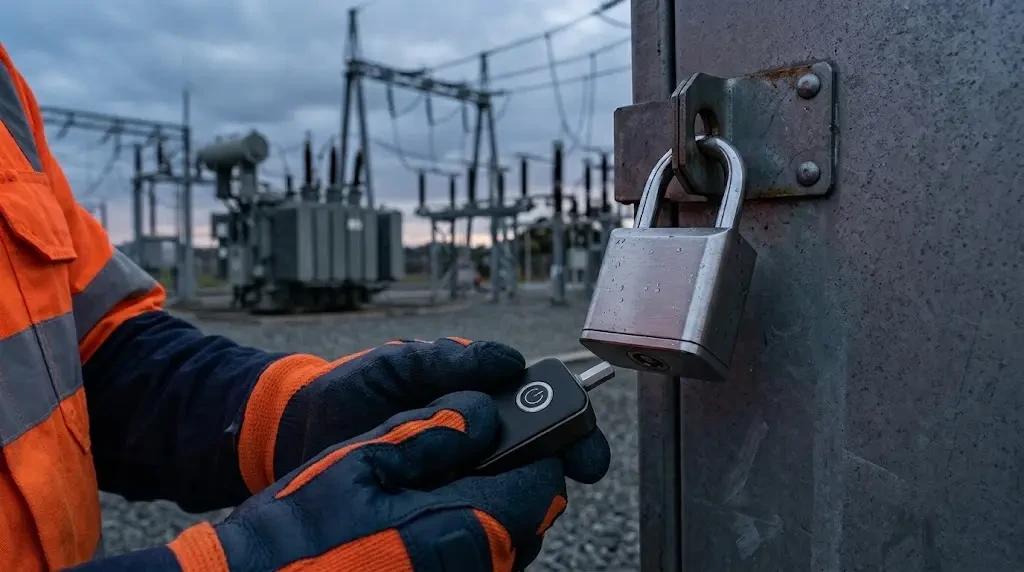
Key-powered passive smart locks fundamentally resolve this dilemma by shifting the power source and computational logic entirely into an intelligent, rechargeable electronic key. The lock cylinder itself contains no battery, no wiring, and zero internal power storage. Instead, micro-energy and AES-128/256 encrypted communication transfer instantaneously upon physical contact between the key and cylinder.
This mechanical-electronic convergence delivers four mission-critical operational advantages for utility grids:
- Zero Lock-Side Maintenance: Built to IP68 weatherproofing standards, the lock cylinders resist salt spray, UV degradation, water immersion, and severe EMI without chemical battery maintenance cycles.
- Closed-Loop Work Order Enforcement: Access rights are tied dynamically to digital dispatch orders. Field crews receive precise, time-limited authorizations on their mobile maintenance app, which pushes permissions to the electronic key via BLE. An unassigned feeder cabinet or grounding switch simply cannot be engaged.
- Complete Audit Trails: Every access attempt—successful or denied—is timestamped and logged directly in the key's memory and synchronized to the central SCADA/asset management dashboard upon mobile uplink.
- Enhanced Human Safety (Anti-Misoperation): By integrating physical interlocks with sequence-based authorization, utilities effectively neutralize accidental energization and unauthorized line access.
For grid operators modernizing their transmission and distribution infrastructure, passive smart locking transforms dumb, passive steel padlocks into an intelligent, audit-ready physical cyber-defense layer—without ever sending technicians into the field to change a battery.