Battery-Free Smart Locks for Municipal Facilities: Q&A
Battery swaps drive most campus smart lock failures. This expert Q&A explains how NFC and Kinetic Locks remove lock batteries from lockers and municipal utility doors.
- #smart campus
- #municipal infrastructure
- #lockers
- #battery-free smart lock
- #NFC lock
- #kinetic lock
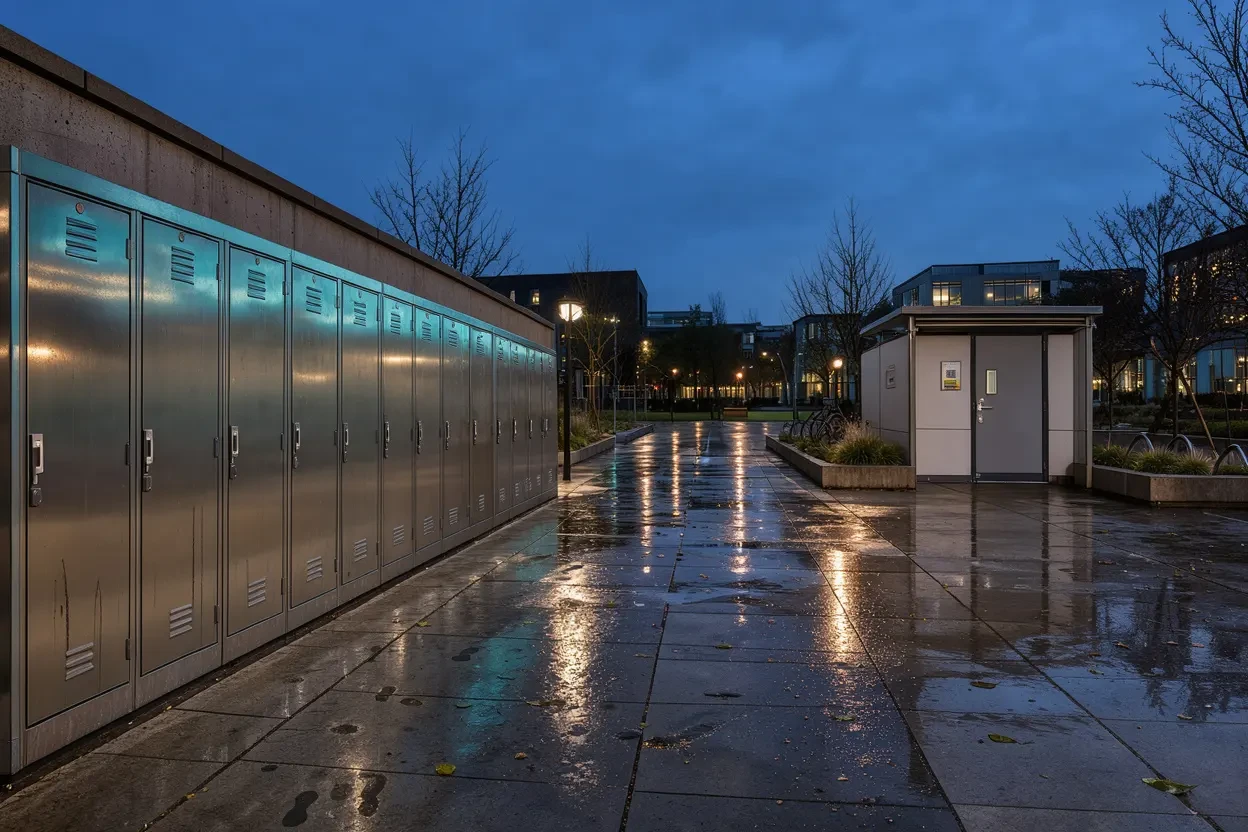
Campus lockers and municipal utility doors are high-touch, widely spread and rarely staffed, which is a hard environment for any lock that runs on batteries. We put the questions facility managers ask most about battery-free smart locks for municipal facilities to a field perspective.
Q: What actually goes wrong with battery-powered locks?
A: Mostly the batteries. One campus maintenance software vendor, Oxmaint, attributes 78% of campus smart lock failures to them. It estimates that a 200-lock residence hall needs 40 to 60 battery swaps a year. Battery-free lock bodies take that whole task off the work order list. They also carry no cell that can leak or fail.
Q: How do NFC and Kinetic Locks work without a battery?
A: An NFC Lock draws power from the user's smartphone. In a deployment documented by iLOQ, Amsterdam's municipality secured drainage stations this way. Service staff stopped collecting keys from the office, and two employees each saved two hours of key-return travel a week. The trade-off is that every user needs an NFC-capable phone, and the lock is rated from -20 °C to +55 °C at IP65, so it is best kept indoors or under cover.
A Kinetic Lock generates its own energy when the user turns the knob. Its lock body is rated from -40 °C to +80 °C at IP68, which suits outdoor kiosks, pump houses and exposed locker banks.
Q: Does going battery-free matter for procurement policy?
A: Increasingly, yes. The EU Batteries Regulation has applied since February 2024 and sets collection targets for waste portable batteries of 63% by 2027 and 73% by 2030, according to Cuatrecasas. Every lock battery you never buy is one you never have to collect.
The Takeaway on Battery-Free Smart Locks for Municipal Facilities
Both lock types use AES-128 or stronger encryption, typically complete energy harvesting, authentication and unlocking within 3 seconds, and are rated for at least 10,000 unlocking cycles. Use NFC Locks where staff carry managed phones, and Kinetic Locks where weather is harsh. Want a site-by-site assessment? Contact us to map your lockers and utility doors.
Sources
1. Smart Lock System Maintenance for Campuses — Oxmaint — https://oxmaint.com/industries/education/smart-lock-system-maintenance-campuses 2. Good Advice Convinced the Municipality of Amsterdam to Choose iLOQ — iLOQ — https://iloq.com/pl/references/good-advice-convinced-the-municipality-of-amsterdam-to-choose-iloq 3. New EU Regulation on Batteries — Cuatrecasas — https://www.cuatrecasas.com/en/global/public-law/art/new-eu-regulation-on-batteries